


This Week
This Diwali, India bought more from 10-minute apps than ever before. And D2C brands are quietly rebuilding their whole business around that shelf, and the kirana store next to it. That is our Big Story.
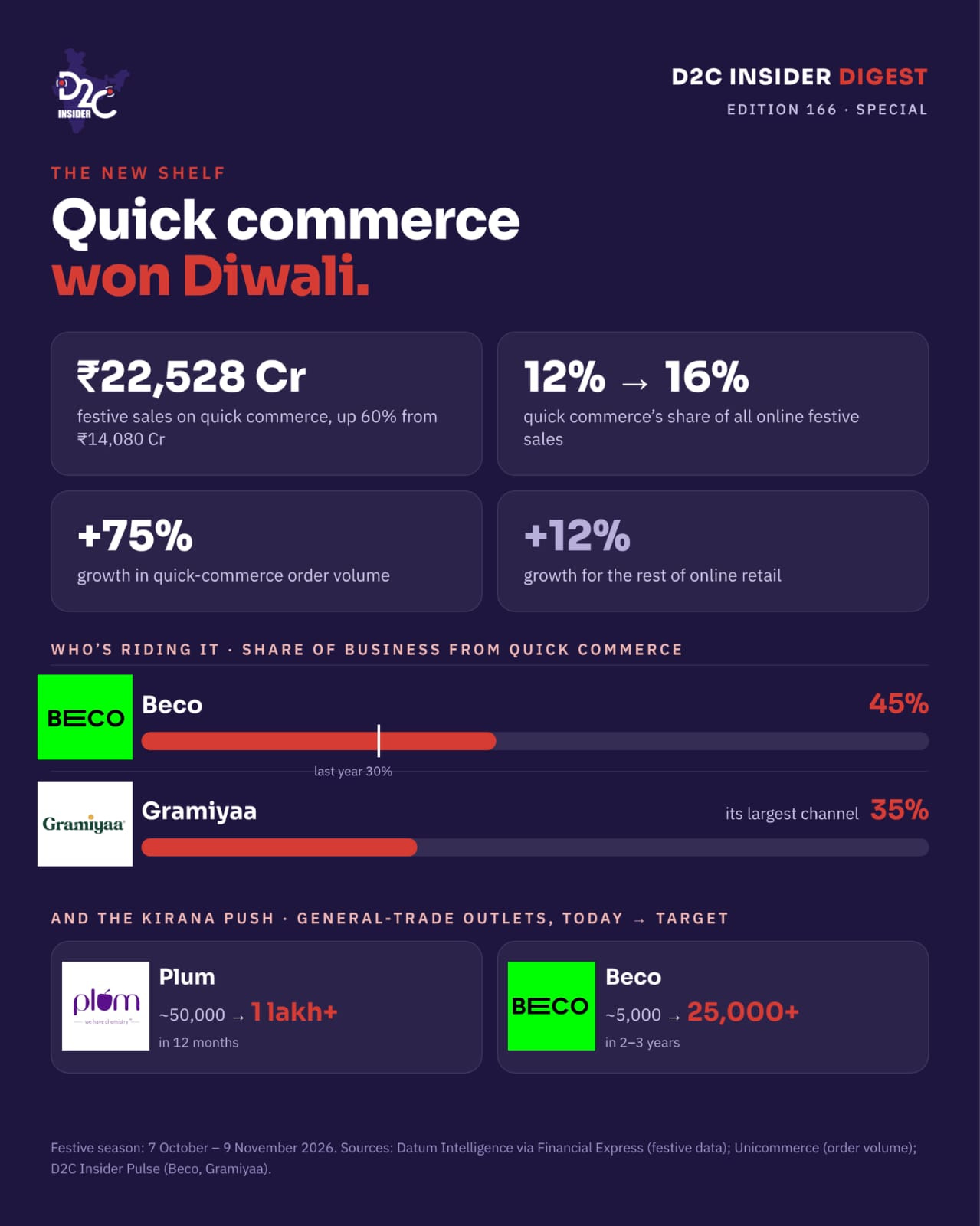
The new shelf: Quick commerce did about ₹22,500 Cr in festive sales, up 60%. Beco now gets 45% of its revenue there, and Gramiyaa 35%.
The money: A quiet week for cheques: 3 consumer rounds, about ₹15 Cr disclosed, led by Bucketlistt and Hundo Pizza.
The number: 100 million. That is how many eyewear units Lenskart wants to serve in India every year, up from 32 million today.
New this week, The Diwali Desk: what sold, who grew, and the numbers behind India’s quick-commerce Diwali.
Plus: The Report Card returns, and this week’s poll asks you to call the future of D2C.
The Big Story: The New Shelf
What happened
The festive sales numbers are in, and one channel ran away with them.
Quick commerce did about ₹22,528 Cr in festive sales (7 October to 9 November), up 60% from ₹14,080 Cr last year. Its share of all online festive sales rose from about 12% to about 16%. The rest of online retail grew only about 12% (Datum Intelligence via Financial Express, reported by Lapaas Voice).
At the same time, three D2C brands showed how they are rebuilding around this new shelf, and the kirana store next to it:
Beco now gets about 45% of its revenue from quick commerce, up from 30% a year ago. It also wants to grow from about 5,000 general-trade stores to 25,000+ in two to three years.
Gramiyaa made quick commerce its largest channel, at 35% of the business. It got there only after months of operating losses, high commissions and heavy ad spend.
Plum wants to double its general-trade reach, from about 50,000 outlets to over 1 lakh in 12 months. Online is still about 70% of its sales.
Why it matters
For ten years, “D2C” meant your own website and the big marketplaces. That is no longer where the growth is.
Quick commerce and kirana stores work like a physical shelf. Space is limited, products that sell fast get more of it, and a product that is out of stock simply disappears. The rules of FMCG now apply to digital-first brands.
Our view
Quick commerce is not “online”. It is a supermarket you open on your phone. Gramiyaa’s turnaround proves it. It stopped losing money only when it began acting like a supermarket supplier: planning city by city, keeping stock available, cutting slow products and holding prices.
The smartest brands now use both shelves together. Quick commerce builds demand in big cities. Kirana stores take the brand to Tier II and Tier III towns, where about 70% of Plum’s general-trade sales came from in Q2 FY26.
The risk is cost. Commissions and ad fees on these apps are high, and Gramiyaa paid for its lesson with months of losses.
What to watch
Whether quick-commerce platforms raise commissions now that brands depend on them.
Plum’s push to 1 lakh outlets, and whether those stores stay profitable.
Beco’s target of ₹2,000 Cr in turnover in three to four years, built on quick commerce and kirana.
The Deal Sheet
3 consumer rounds. About ₹15 Cr disclosed. A quiet week for cheques.
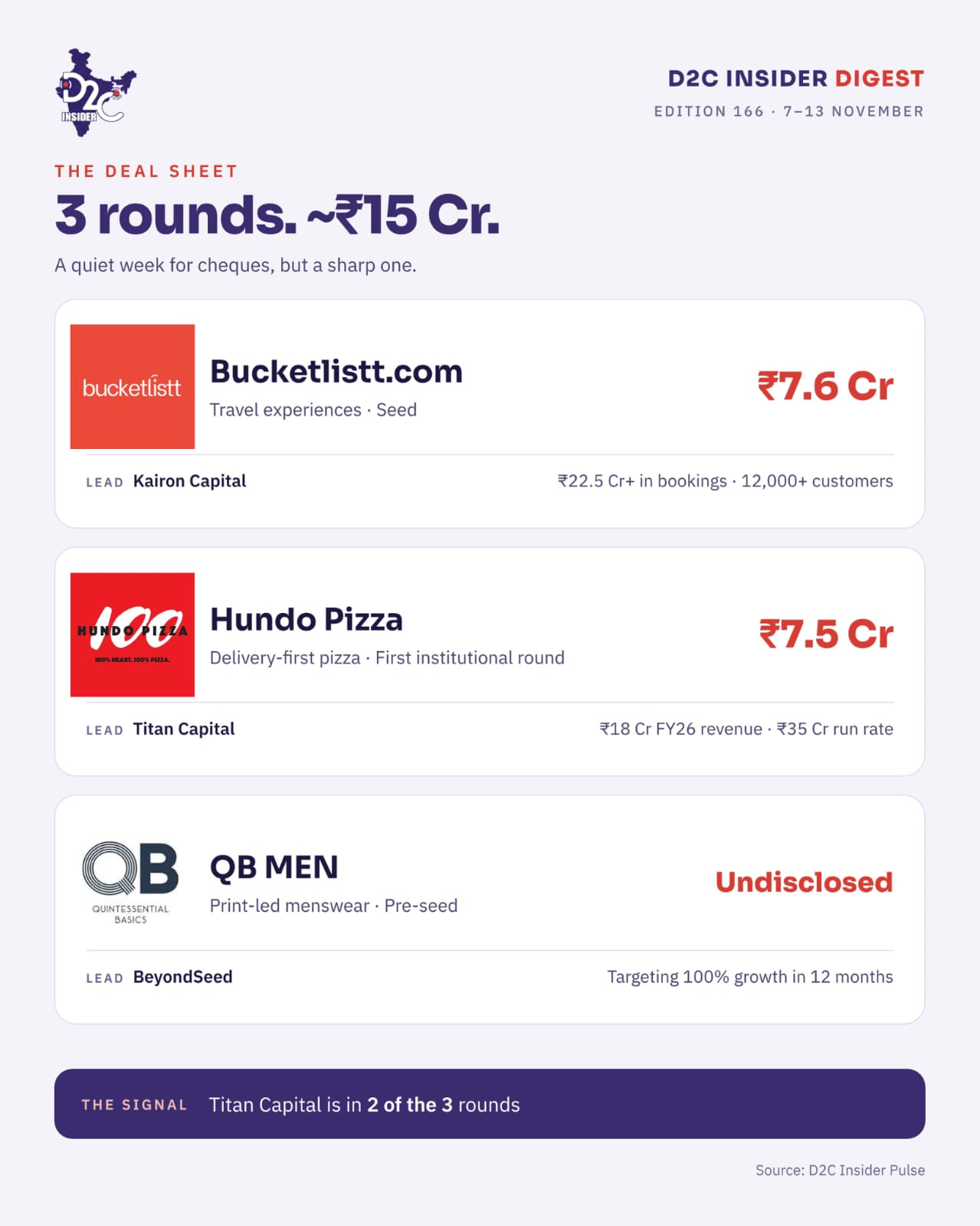
Bucketlistt.com · Travel experiences · Seed · ₹7.6 Cr · Lead investor: Kairon Capital (Titan Capital participated)
Hundo Pizza · Delivery-first pizza · First institutional round · ₹7.5 Cr · Lead investor: Titan Capital (Indian Silicon Valley Capital participated)
QB MEN · Print-led menswear · Pre-seed · Undisclosed · Lead investor: BeyondSeed (Rajkot Ventures and Prajay Advisors participated)
The signal: Titan Capital is in two of the three rounds. And Hundo Pizza shows what investors want at the earliest stage: it was bootstrapped for six years, made ₹18 Cr in FY26 and is already at a ₹35 Cr run rate.
The Number: 100 million
That is how many eyewear units Lenskart wants to serve in India every year. Today it serves 32 million, so the target is about 3X.
To get there, it has made blue-light filtering lenses standard on eligible glasses at no extra charge. On Children’s Day (14 November), it will give free prescription glasses to the first 1 lakh eligible children aged 5–12, with families paying ₹199 for fitting.
Why it matters: Last week, Lenskart posted a ₹232 Cr quarterly profit. This week it is using that profit to grow the whole market, not just its share of it. That is what a category leader does.
The Report Card
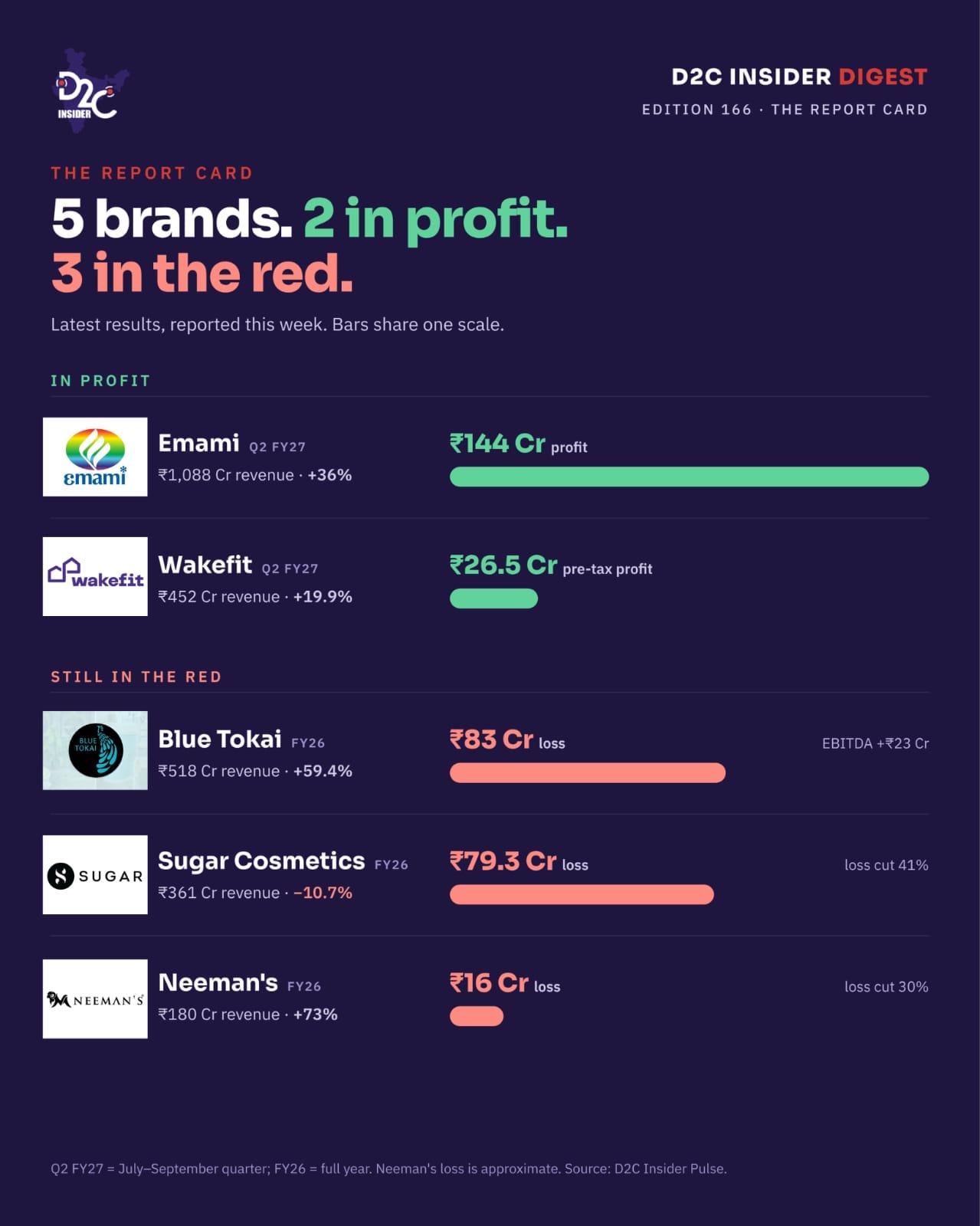
The Report Card returns. Five consumer brands reported results this week.
In profit:
Emami · Q2 FY27 · ₹1,088 Cr, up 36% · ₹144 Cr profit (down 3%, as a tax benefit ended)
Wakefit · Q2 FY27 · ₹452 Cr, up 19.9% · ₹26.5 Cr pre-tax profit, up 66%
Still in the red:
Blue Tokai · FY26 · ₹518 Cr, up 59.4% · ₹83 Cr loss, up 53.7% (EBITDA positive at ₹23 Cr)
Sugar Cosmetics · FY26 · ₹361 Cr, down 10.7% · ₹79.3 Cr loss, cut by 41%
Neeman’s · FY26 · ₹180 Cr, up 73% · about ₹16 Cr loss, cut by 30%
Our view: Two very different ways to cut a loss. Neeman’s cut it by growing sales faster than costs. Sugar cut it by spending less, but its sales fell. The first is a path to profit. The second only buys time.
A note on Neeman’s: Two weeks ago we called Neeman’s a brand “already making money”, based on its statement that it had turned profitable. Its FY26 filing shows a full-year loss of about ₹16 Cr, so that profitability must refer to a more recent period. We should have made that clear.
The Diwali Desk
New section. The festive season, in numbers.
Quick commerce won Diwali. Festive sales on 10-minute apps rose about 60% to ₹22,528 Cr. Order volumes rose 75%, and platforms went into the season with 7,153 dark stores, up 34% (Lapaas Voice).
Online overall slowed. Total online festive sales grew about 17%, down from 25% last year, and below forecasts of 25–29%. Phones made up about 25% of online festive sales, down from 35%.
BlueStone grew 45% from 1 October to 8 November. More people bought, but the average price stayed flat, with strong demand for everyday and entry-level pieces.
Mannlich saw daily gift-pack orders jump nearly 300%, and its average order value doubled. The men’s grooming brand is EBITDA profitable and targets ₹100 Cr ARR within 18 months.
Quick Hits
Drools is targeting triple-digit export growth in FY27, led by the UAE. Exports are under 5% of the business today.
QUE Universe, the eyewear brand backed by Shikhar Dhawan, targets ₹100 Cr revenue in two years, from about ₹1 Cr a month today. The UAE is its first market abroad.
thinKitchen targets 3–5X growth in five years, with 35+ global brands, its own label Culinex and a family-owned factory.
Blue Tokai plans to grow to 800 outlets by FY30.
Wakefit added 41 stores in one quarter, and now runs 205 company-operated stores in 137 cities.
We will share the results next Saturday.
D2C Insider Updates
Super Angels Pulse starts this Friday. Episode 1 of our live series on the operator-to-angel journey is on 20 November, 6–7 PM IST on Zoom, with Arjun Vaidya, Co-Founder of V3 Ventures. Hitaysh Dhingra (The Man Company) follows on 27 November, and Shaily Mehrotra (Fixderma) on 4 December. Register here.
That’s the week. Don’t forget your pick for The Poll, and tell us what you’re seeing on the new shelf. We read every message.
See you next Saturday.
The D2C Insider Editorial Team