


This Week
The FY26 numbers are landing, and they all point to the same question: how much does growth really cost? That is our Big Story.
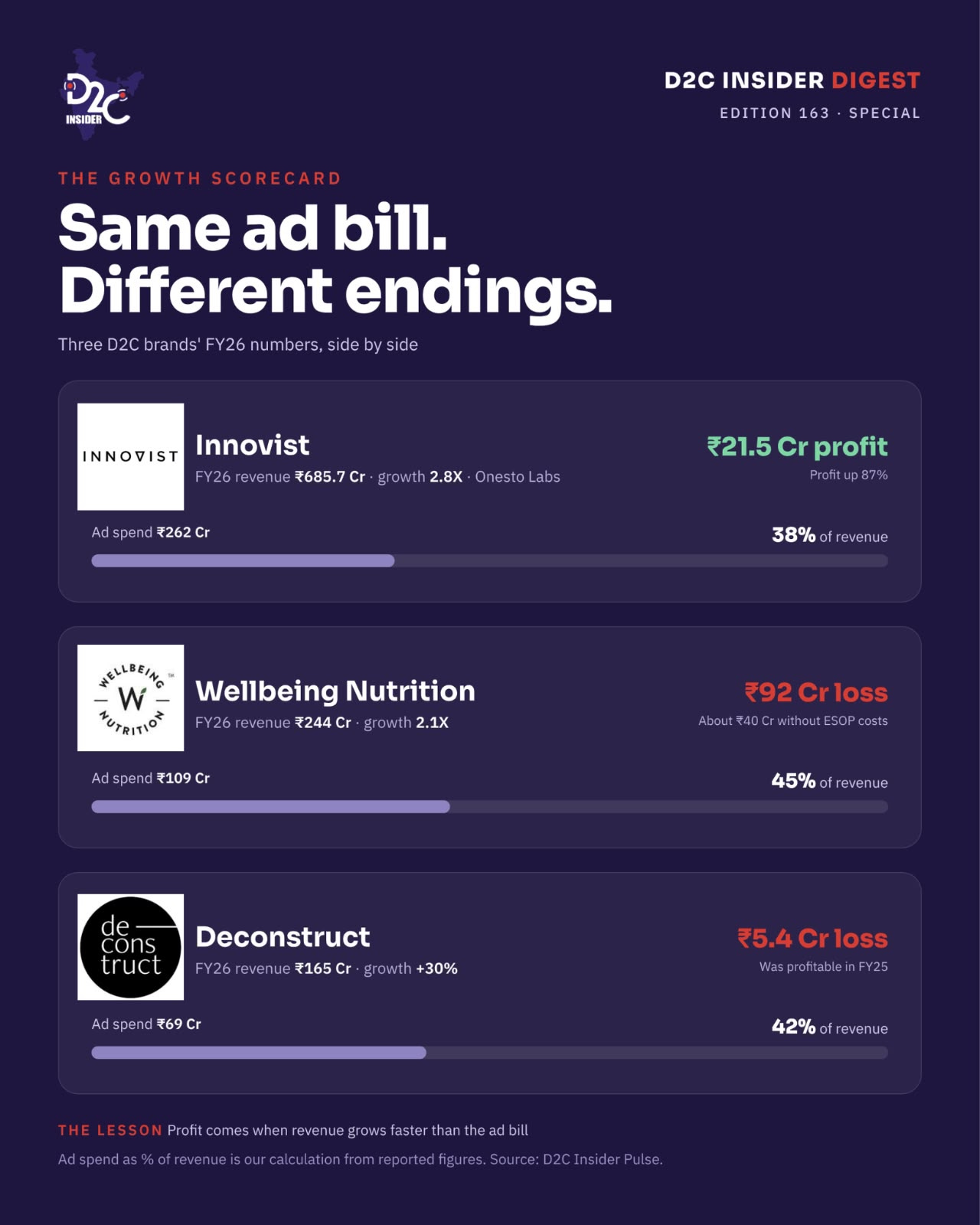
The bill: Innovist, Wellbeing Nutrition and Deconstruct all grew fast in FY26. Each spent between 38% and 45% of revenue on ads (our calculation). Only one of them made a profit.
The money: 6 consumer rounds, over ₹650 Cr. The Pant Project’s ₹109 Cr Series B is the biggest D2C cheque.
The number: ₹1,000 Cr. That is roughly what Chapter Home is valued at, about a year after it was founded.
New this week, IPO Watch: Cult.fit has SEBI’s go-ahead, Burma Burma has filed, and BlueStone’s latest quarter shows what public markets reward.
The Big Story: Who Pays for Growth?
What happened
Three well-known D2C brands filed their FY26 numbers this week. All three grew fast. All three spent heavily on ads. Their bottom lines could not be more different.
Innovist (the company behind Onesto Labs) grew 2.8X to ₹685.7 Cr. It spent ₹262 Cr on ads, about 38% of revenue, and still made a ₹21.5 Cr profit, up 87%.
Wellbeing Nutrition doubled revenue to ₹244 Cr. It spent ₹109 Cr on ads, about 45% of revenue, and lost ₹92 Cr (around ₹40 Cr without ESOP costs).
Deconstruct grew 30% to ₹165 Cr. It spent ₹69 Cr on ads, about 42% of revenue, and slipped to a ₹5.4 Cr loss after a profitable FY25.
Ad spend as a share of revenue is our calculation from the reported figures.
Why it matters
In Indian D2C, ads are the toll on the online highway. These three paid 38–45 paise of every rupee they earned just to be seen.
That toll is fine while growth is fast. It becomes a problem when growth slows and the toll does not. Deconstruct’s expenses grew 48.7% while revenue grew 30%. That gap is what turned a profit into a loss.
Our view
The ad bill alone does not decide who wins. What decides it is whether revenue grows faster than the bill. Innovist grew 2.8X, so a 38% ad ratio still left room for profit. Deconstruct’s growth slowed to 30%, and the same kind of ad ratio ate its margin.
Buyers seem to agree that the brand is worth more than the loss. USV has agreed to buy 79% of Wellbeing Nutrition at a ₹1,583 Cr valuation, about 6.5X its FY26 revenue (our calculation), despite the ₹92 Cr loss.
The way out is the same playbook we saw in last week’s ₹1,000 Crore Race: more repeat buyers, more offline sales and less dependence on paid clicks.
What to watch
Whether Deconstruct cuts its ad ratio in FY27, or chooses growth over profit again.
How Wellbeing Nutrition’s spending changes once USV takes control.
Innovist’s next move. At ₹686 Cr and profitable, it is now a quiet contender in the ₹1,000 Crore Race.
The Deal Sheet
6 consumer rounds. Over ₹650 Cr disclosed (our calculation, with dollars at about ₹88).
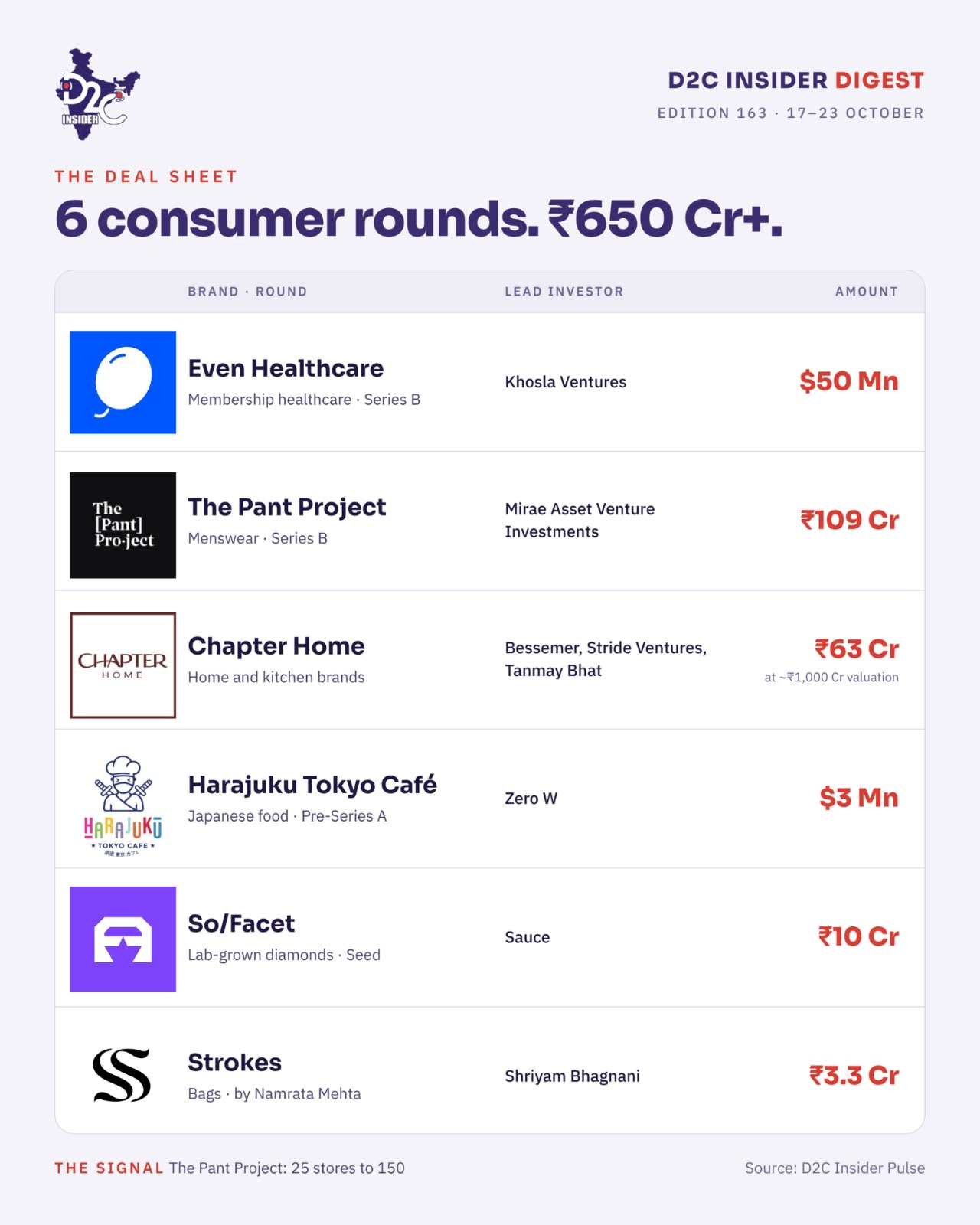
Even Healthcare · Membership healthcare · Series B · $50 Mn · Lead investor: Khosla Ventures (Alpha Wave participated)
The Pant Project · Menswear · Series B · ₹109 Cr · Lead investor: Mirae Asset Venture Investments (India)
Chapter Home · Home and kitchen brands · Not disclosed · ₹63 Cr · Investors: Bessemer Venture Partners, Stride Ventures, Tanmay Bhat and family offices (about ₹1,000 Cr valuation)
Harajuku Tokyo Café · Japanese food · Pre-Series A · $3 Mn · Lead investor: Zero W
So/Facet · Lab-grown diamond jewellery · Seed · ₹10 Cr · Lead investor: Sauce
Strokes by Namrata Mehta · Bags and accessories · Not disclosed · ₹3.3 Cr · Investor: actor Shriyam Bhagnani
The signal: Stores again. The Pant Project wants to go from 25 to 150 stores, and Chapter Home plans physical retail touchpoints. Also note the names on the cap tables: Tanmay Bhat in Chapter Home, Shriyam Bhagnani in Strokes. Last week’s Celebrity Shelf keeps growing.
The Number: ₹1,000 Cr
That is roughly the valuation at which Chapter Home raised ₹63 Cr this week. The company was founded only in 2025, by former PharmEasy leaders.
It is building several consumer brands across home furnishings, cookware, décor and kitchen appliances, and plans its own physical retail touchpoints.
Why it matters: Two weeks ago our Big Story was the battle for the Indian home. Investors are now pricing that battle at ₹1,000 Cr for a team, a plan and a category, before the brands have had time to prove themselves.
IPO Watch
New section. Four consumer companies moved closer to, or performed in, the public markets this week.
Cult.fit has SEBI’s observations for its IPO: a ₹950 Cr fresh issue plus an offer for sale of up to 17.86 crore shares. FY26 operating revenue rose 36% to ₹1,720.6 Cr, across 708 centres in 77 cities.
Burma Burma‘s parent, Hunger Pangs, filed its DRHP for a ₹150 Cr fresh issue. It runs 22 restaurants in nine cities and made ₹156 Cr in FY26.
BlueStone, already listed, grew Q2 FY27 revenue 45% to ₹745 Cr and cut its net loss by 91.6% to ₹4.37 Cr. It is profitable for the half year, at ₹1.59 Cr. Its market value is about ₹11,305 Cr.
Popees grew FY26 revenue 20% to ₹161.9 Cr with ₹8.4 Cr profit. A proposed ₹511.3 Cr share-swap would bring the operating business under Popees Baby Care India Ltd.
Our view: Public markets reward the boring things: growth with a falling loss, and a path to profit. That is the same test as our Big Story.
Store Watch
100 is the new milestone. Three brands crossed or neared 100 stores this week, and all of them want to double.
Asian Footwears: 100 exclusive stores, 150 by March 2027. It was on last week’s ₹1,000 Crore Race scoreboard.
Limelight Lab Grown Diamonds: 100+ stores in 45 cities, 200 in 2027.
Contraband by Ananya Birla: About 100 premium retail outlets, 200 by the end of 2027. It also launched a new perfume, 5 PM Somewhere.
The Pant Project: From 25 stores to 150 in two to three years.
SMOOR: 75th outlet, an all-day dining lounge in Bengaluru, ten years after it started.
YatriKart: A ₹120 Cr deal with MMG Group for 1,000 Quick Stop convenience stores in five years, starting with 100 in Delhi NCR.
Fabindia: 361 stores, now pushing furniture and home projects, and selling on Blinkit and Myntra’s M-Now.
The Arvind Store: Styling studios planned across 150+ outlets, on the way from ₹1,000 Cr+ to a ₹2,000 Cr target.
Harajuku Tokyo Café: 10 new outlets, plus Bengaluru and Chandigarh, by December 2026.
Quick Hits
MillD hit a ₹110 Cr run rate in eight months with high-protein atta. It is raising capacity 10X and targets ₹700 Cr in FY29.
Yes Madam grew Q2 FY27 revenue 69% to ₹79.4 Cr. Its run rate is now ₹402 Cr.
Nutrifresh grew 51% to ₹219.3 Cr in FY26 and targets ₹400 Cr in FY27, backed by a ₹90 Cr tranche from the US DFC.
Ultraviolette launched the X-47 Venom electric motorcycle at ₹2.65 lakh, with a claimed 343 km range. Deliveries start in November, and Europe follows at EICMA in Milan on 3 November.
Ather Energy expects exports to matter in five to seven years. A new Maharashtra plant adds 10 lakh units of capacity, and the Konarc launches at ₹79,999.
Curefoods is piloting MegaBite, its own budget food delivery app, in Bengaluru’s HSR Layout. Dishes cost ₹49–199, with no delivery or platform fees.
D2C Insider Updates
FRONTIER is heading to Bengaluru. After Mumbai, our next AI summit for D2C founders is being planned for Bengaluru. Dates and speakers coming soon. Register your interest.
That’s the week. If your brand has cracked the ad bill, reply and tell us how. We read every message.
See you next Saturday.
The D2C Insider Editorial Team