


D2C Insider Digest · Edition 159
Good morning,
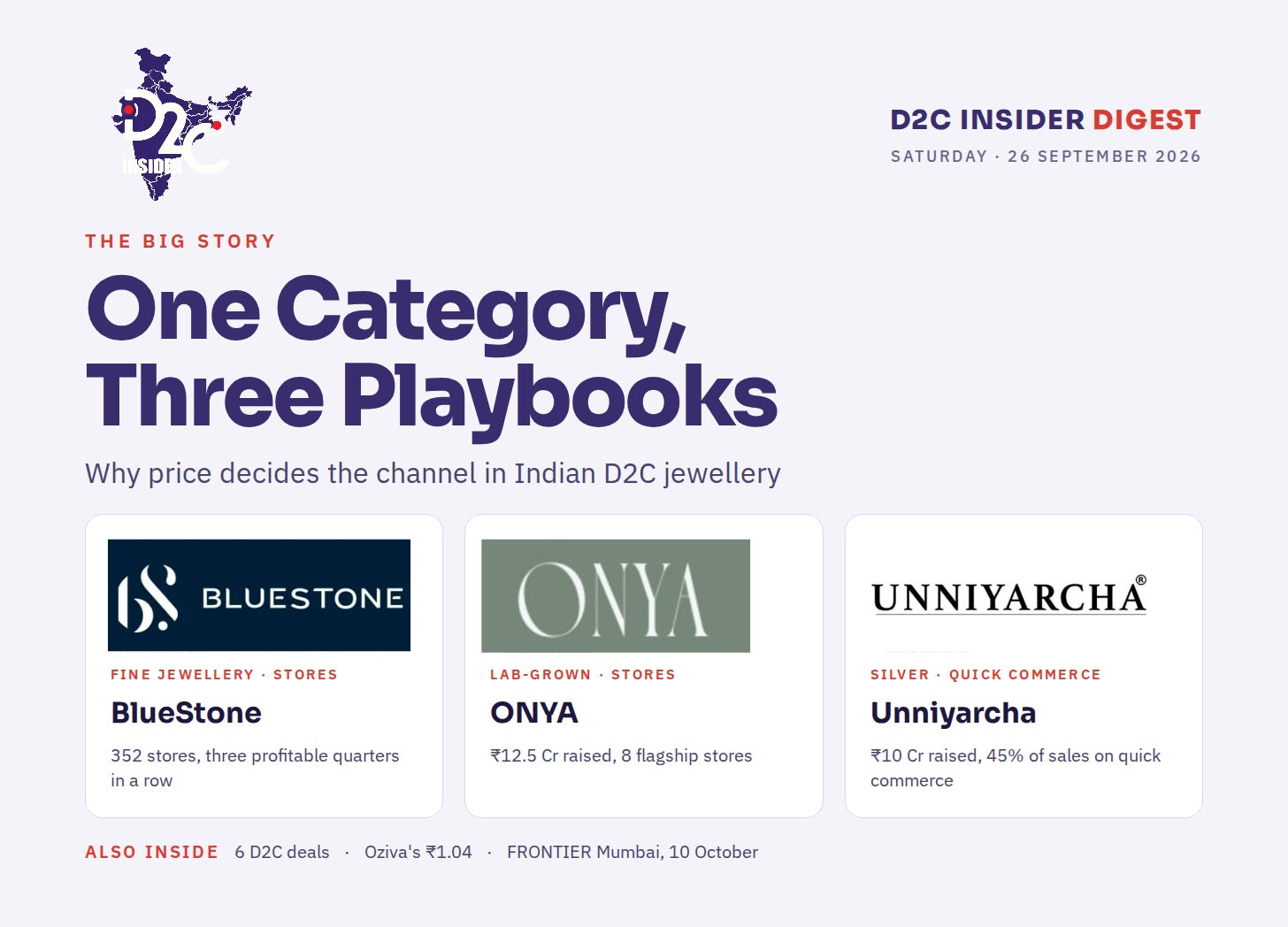
Three jewellery stories landed this week, at three very different price points. Together they show why jewellery has become one of the most reliable categories in Indian D2C, and why the right playbook depends on what your product costs.
Inside: the jewellery playbooks, six D2C deals, and the number that explains Oziva’s year.
The Big Story: One category, three playbooks
What happened
At the top, BlueStone showed what a full cycle looks like. Accel and 360 ONE sold a combined 4.07% stake for about ₹513 crore this week. The buyers were institutions including Mirae Asset, Nippon India, SBI Life and Bajaj Life. BlueStone has now posted three profitable quarters in a row. In Q1 FY27 it made a net profit of ₹5.96 crore, against a loss of ₹34.74 crore a year earlier. It runs 352 stores across 139 cities.
In the middle, lab-grown diamonds are going offline. ONYA raised ₹12.5 crore in a pre-Series A round led by Divisa Family Office. It has eight flagship stores across Bengaluru, Pune and Hyderabad, and ₹3.5 crore in monthly recurring revenue. Next, it plans both company-owned stores and franchises. Limelight, #6 in our Top 10 D2C Funding Deals of 2026, is raising for stores too.
At the entry level, silver is selling in 10 minutes. Unniyarcha raised ₹10 crore led by Sauce VC. Its pieces typically cost ₹1,000 to ₹3,000. Half its sales come from its own website, and 45% from quick commerce. It has no stores at all.
Why it matters
Jewellery solves problems most D2C categories struggle with. It doesn’t expire, so inventory holds its value. People buy it again for weddings, festivals and gifts. And it carries enough value per order to pay for real distribution, whether that’s a store or a dark store.
But there’s no single jewellery playbook. The channel follows the price. At ₹50,000, a customer wants to see and touch the piece, and to trust the seller. At ₹2,000, it’s a gift decided on the way to a dinner.
Our view
Price decides the channel, and the brands winning in jewellery know exactly which one they’re in. Above roughly ₹10,000, stores are worth the cost because they build trust. Below ₹3,000, quick commerce may be the most efficient channel in Indian D2C right now. The risk sits in the middle, where brands try to do both before they’ve mastered either.
BlueStone’s stake sale matters beyond BlueStone. When venture funds sell to mutual funds and insurers at a ₹12,000+ crore market value, it tells every investor that consumer brands in India can deliver an exit. That makes the next early cheque easier to write.
What to watch
Whether ONYA-style franchises keep store quality consistent as they scale. Franchising is the fastest way to add stores, and the fastest way to dilute a premium brand.
The Deal Sheet: 19–25 September
Six D2C brands raised money this week, all at an early stage. The five disclosed rounds add up to ₹44.5 crore.
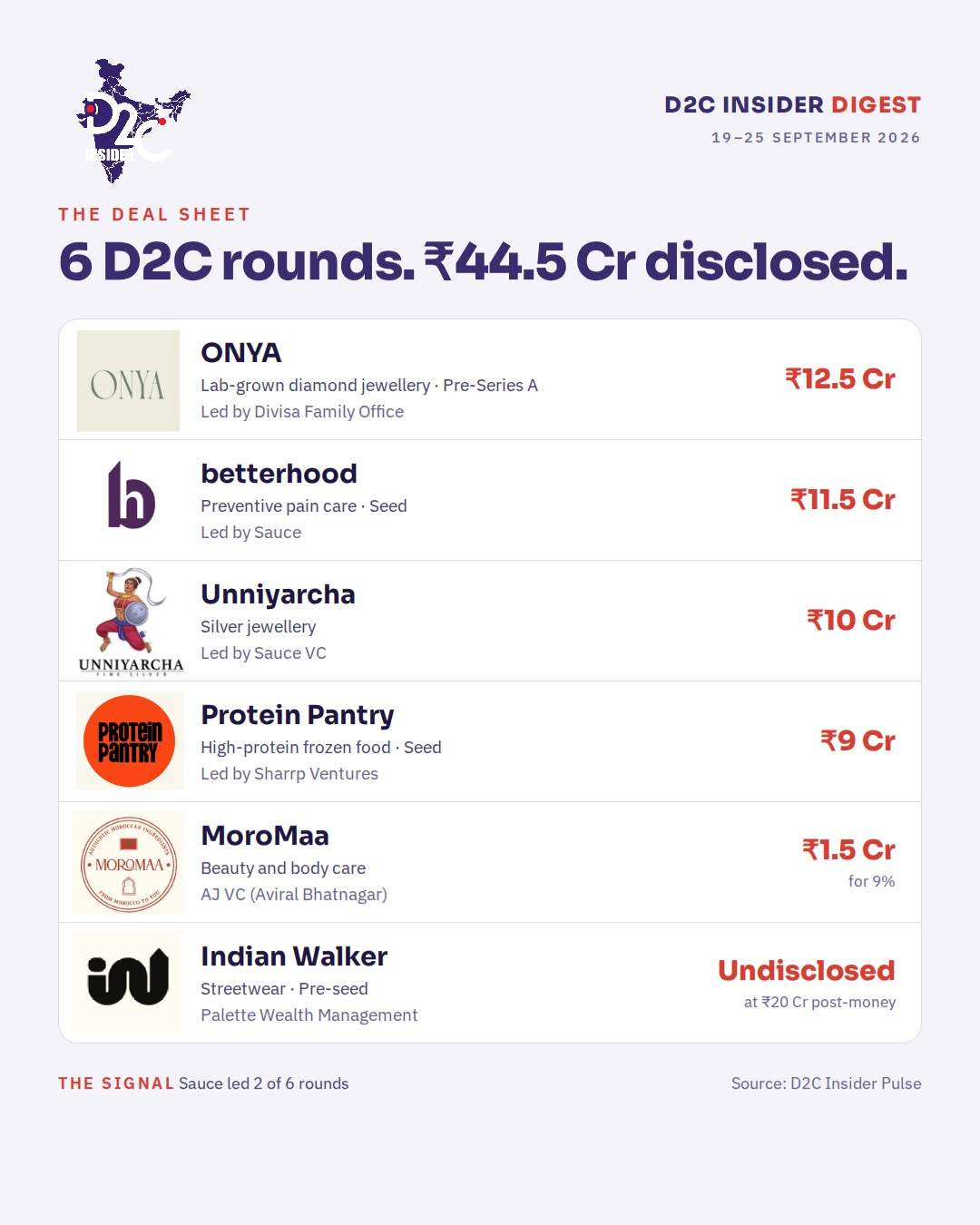
ONYA · Lab-grown diamond jewellery · Pre-Series A · ₹12.5 Cr · Led by Divisa Family Office
betterhood · Preventive pain care · Seed · ₹11.5 Cr · Led by Sauce, with Kairon Capital
Unniyarcha · Silver jewellery · ₹10 Cr · Led by Sauce VC
Protein Pantry · High-protein frozen food · Seed · ₹9 Cr · Led by Sharrp Ventures
MoroMaa · Beauty and body care · ₹1.5 Cr for 9% · AJ VC (Aviral Bhatnagar)
Indian Walker · Streetwear · Pre-seed · Undisclosed, at ₹20 Cr post-money · Palette Wealth Management
Also funded, consumer-adjacent: Ultraviolette raised $85 Mn led by Yali Capital and TDK Ventures, and quick-commerce healthcare platform Rio Health raised ₹43.08 crore led by Version One Ventures.
The signal. Sauce led two of the six rounds, and both already have a distribution edge: Unniyarcha earns 45% of its sales on quick commerce, and betterhood works with a community of 7,000+ physiotherapists. At seed stage, investors are backing brands with a distribution edge from day one.
The Number: ₹1.04
That’s what HUL-owned Oziva spent to earn every rupee of revenue in FY26, according to its filings, as reported by Entrackr. Revenue grew 80% to ₹463.4 crore. But ad spend more than doubled to ₹246.2 crore, and losses widened 4.4 times to ₹18.5 crore.
The lesson for founders: growth bought with advertising shows up in the revenue line and the loss line at the same time. Even with HUL behind it, Oziva now needs repeat customers to do the work that ads did last year.
Quick Hits
Nykaa and L’Oréal team up to back beauty startups. Nykaa and BOLD, L’Oréal’s venture fund, will jointly make minority investments in emerging Indian beauty brands, with founders keeping operational and creative control. For beauty founders, that’s capital with shelf space attached.
AceVector goes public. The parent of Snapdeal, Unicommerce and Stellaro Brands opened its ₹420 crore IPO on 25 September, closing on 29 September. It raised ₹189 crore from anchor investors, and its FY26 revenue grew 29% to ₹510.38 crore.
Amazon’s quick commerce bet is getting expensive. Amazon Now and Amazon Fresh reported ₹3,065 crore in FY26 revenue and a ₹1,158 crore loss. Amazon runs around 750 quick commerce stores and is targeting about 1,300 by April. For D2C brands, that’s one more 10-minute shelf to plan for.
Captain Fresh crosses ₹5,000 crore. Its FY26 revenue rose 52% to ₹5,169 crore, and adjusted EBITDA grew 2.7 times to ₹371 crore. It is now targeting ₹10,000 crore in FY27 as a global packaged seafood business.
Ultraviolette heads to the US. The Bengaluru electric motorcycle brand raised $85 Mn and plans to enter the US in 2027, another Indian consumer brand building for global markets.
For daily coverage, read D2C Insider Pulse.
D2C Insider Updates
FRONTIER Mumbai is two weeks away. India’s D2C AI Summit comes to Mumbai on Saturday, 10 October, at the Novotel Mumbai International Airport, Andheri East, from 9 AM to 9 PM. The first edition in Gurugram brought together 150+ founders and CXOs, 100+ brands and 40+ speakers, around one question: what is AI actually changing inside a consumer business?
Mumbai goes further, with hands-on AI workshops, operator-led panels, live case studies, AI Experience Zones and curated networking. Special invitees include Anupam Mittal (People Group), Anurag Kedia (Pilgrim), Dhyanesh Shah (Mosaic Wellness), Keshav Biyani (The Good Bug), Pallavi Mohadikar (Palmonas), Sumedh Battewar (Zoomies), Nikhil Vora (Sixth Sense Ventures) and Tarun Davda (Z47). Supporting partners are Triswan and Techsevin. Reserve your seat →
Next stop: FRONTIER Bengaluru, 28 November. The third edition comes to Bengaluru on Saturday, 28 November, from 9 AM to 9 PM, with Shopflo as co-partner. Special invitees include Siddharth Dungarwal (Snitch), Hemant Malik (ITC Limited), Sarita Raichura (Blume Ventures), Arjun Vaidya (V3 Ventures), Vikas Lachhwani (MCaffeine) and Ibrahim Faruqui (Bessemer Venture Partners). Save the date.
That’s the week.
If this was useful, forward it to one founder who should be reading it. And if you run a jewellery brand, hit reply: stores or quick commerce, which channel is working for you?
See you next Saturday,
The D2C Insider Editorial Team
Daily D2C news on Pulse.